திருக்குறள்
Two lines.
A whole life.
Read all 1,330 couplets of the Tirukkural, see how its ideas connect, and bring your own questions to it.
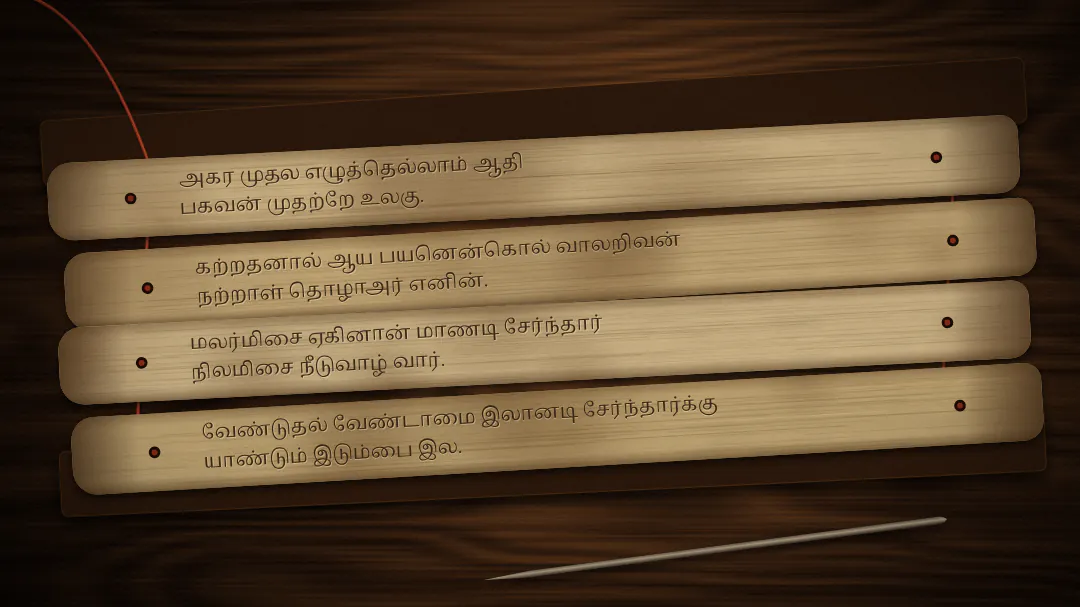
The Kural is about the life you are already living.
Each couplet is two lines long. Together its 133 chapters take up what fills an ordinary life: how to speak, whom to trust, how to earn and spend, how to bear a wrong, what to do with desire.
காலத்தி னாற்செய்த நன்றி சிறிதெனினும்ஞாலத்தின் மாணப் பெரிது.
“A good deed done at the right time, though small, is far greater than the world.”
What are you facing?
Each opens a walk through what the Kural says about it.
The couplet most people know
அகர முதல எழுத்தெல்லாம் ஆதிபகவன் முதற்றே உலகு.
agara muḍala eḻuṭṭellām āḍipagavaṉ muḍaṟṟē ulagu.
“As all letters begin with A, the world begins with the First Lord.”
From: Chapter 1, Praising God
Read a couplet at a time, or see the whole book at once.
Explore lays it all out: every couplet, idea, state of mind and life situation on one map, with the threads between them.

What is on the map
- Chapters
- 133
- Couplets
- 1,330
- Ideas
- 117
- States of mind
- 129
- Life situations
- 58
- Characters
- 4
6,862 connections between them: which couplet defines an idea, which state heals another, which couplets answer which situations.
Point at the map, or tap on a phone. Drag sideways to turn it.
Three parts, 133 chapters, ten couplets in each.
Read it in order, with the Tamil, its romanisation, a plain reading and parimēlaḻagar’s commentary for every couplet.
All 133
Pick any chapter. Read remembers where you stopped.
RighteousnessWealthDesire
Come in however suits you.

Your first five minutes
A short lesson on Kural 100: the setting, the couplet, what it means in plain words, and an example from everyday life.

Write what is on your mind
Reflect suggests the states, situations and couplets your words touch. You keep the ones that fit. Everything stays in this browser.
Follow one thing to the next
Couplets 96, 31 and 757 lead from a sweet word to compassion. Lineage lays chains like this out step by step.
- Kind Speech
- Righteousness
- Wealth
- Compassion
Ask the text
Answers are built from the couplets and show which ones they draw on.
Free to use, private by default.
An AI wrote the English
The readings and the links between couplets were written by an AI (Anthropic’s Claude), not by a scholar or translator. They’re still in draft and need review, so treat them as a reading of the text and not as authority.
Your thoughts stay with you
Reflections are saved on this device, in this browser. They don't sync anywhere; export them when you want to move them.
AI is optional
Reading, search, the graph and suggestions all work without a language model. If you connect one, only the text you choose is sent.
Built on open texts
The Tamil starts from an open dataset and was checked line by line against Project Madurai and Tamil Wikisource. parimēlaḻagar’s Tamil comes from Tamil Wikisource.